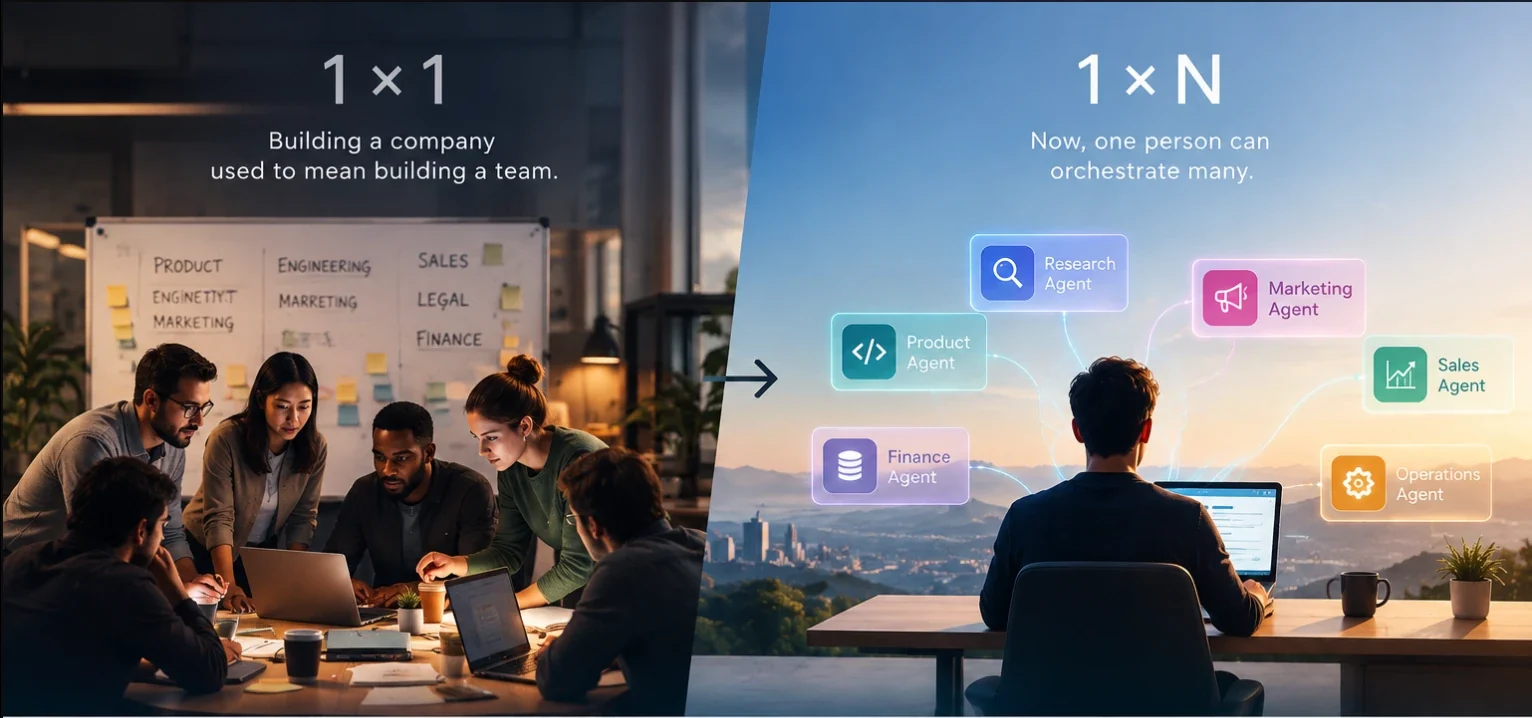
Imagine you have an idea for a business. What's the first thing you think about? Finding a co-founder, an engineer to build the product, someone in sales to sell it, and people to handle legal, finance, and marketing. Before you know it, turning an idea into a business means assembling a team, raising capital, and bringing everyone together.
Starting a company was fundamentally a people problem. You needed the right people with the right skills, enough capital to bring them on board, and the ability to get them working towards the same goal. Entrepreneurship was expensive, and not just in monetary terms. Hiring, training, coordinating, and managing people all came with costs. Even when the money was available, finding the right people and getting them to work together took time.
Traditionally, if you wanted to build something bigger, you usually had to build a bigger team. More customers meant more people to serve them. More products meant more people to build and sell them. Every new function brought its own hiring and management requirements. Scaling a business meant scaling its workforce.
But I think AI agents could change this equation.
I'm not talking about AI writing emails or generating snippets of code. We've had AI tools that help us perform individual tasks for a while now. The more interesting shift happens when you have multiple agents working across different functions of a business, carrying out tasks and coordinating with one another.
This is what I call the 1×N era: one human orchestrating N agents.
The Company of One
This is the idea I find particularly interesting. What if the minimum viable company becomes one person?
Not because that person does everything themselves, but because they have access to a digital workforce.
Imagine wanting to start something. Traditionally, even if you had a great idea, you'd need people to build the product, find customers, handle marketing, and manage the business. You could do some of these things yourself, but there are only so many hours in a day, and only so much one person can reasonably do.
Now imagine having a digital workforce that can take on many of these responsibilities. You could have agents researching a market, others helping build your product, and others helping you find customers and run marketing campaigns. You would still need to set the direction, make decisions, review the work, and step in when things go wrong. But you wouldn't necessarily need to hire an entire team before you could get started.
The fundamental shift is this: you no longer need to personally possess every capability required to build a company. You need to be able to access, direct, and coordinate those capabilities.
And perhaps the more interesting consequence is what this does to experimentation.
Today, when you start a company, you're making a bet. You commit your time, money, and energy to an idea, hoping it works. Pursuing another idea often means spreading yourself thinner or putting the first one on hold. There's an opportunity cost to every decision.
But what happens when the cost of building and operating a business comes down?
Perhaps you no longer have to bet everything on a single idea. You could test multiple ideas, build prototypes, explore different markets, and see what gains traction. Some will fail, and that's fine. You haven't necessarily spent months hiring a team or raised capital just to find out that an idea doesn't work.
When the cost of execution falls, the cost of experimentation falls with it.
Instead of spending months deciding which idea deserves to become a company, you might be able to test several ideas and let the results help you decide.
And perhaps, as the cost of building a business comes down, the biggest constraint in entrepreneurship will no longer be capability. It will be judgment, ambition, and taste.
The ability to build something, analyse a market, or reach potential customers may become increasingly accessible to individuals. But knowing what to build, which problems are worth solving, and what good actually looks like will still matter enormously.
And perhaps the most important thing of all will be the willingness to experiment and the willingness to start.
You can have access to the best models, the most capable agents, and an entire digital workforce at your disposal. But none of that matters if you never act on an idea.
When capability becomes more accessible, the willingness to use it becomes a differentiator.
The excuses for not trying may become harder to justify.
From an Employee to an Orchestrator
There's another shift happening underneath all of this, and I think it's worth paying attention to.
For a long time, most people thought about their careers in terms of a simple question: What job can I do? Am I an engineer, a designer, a marketer, or a finance professional? Your value was largely tied to the skills you possessed and the work you could personally carry out.
Then computers and software changed the equation. The question increasingly became: What can I do with software? A person who knew how to use the right tools could suddenly do things that would previously have required much more time, effort, or even an entire team.
I think AI agents could take us a step further.
The question becomes: What can I get done by orchestrating intelligence?
Instead of thinking only about the tasks you can perform yourself, you begin to think about the outcomes you can achieve by directing AI agents, combining their capabilities, and getting them to work towards a common goal.
This doesn't mean expertise stops mattering. In fact, understanding a domain well enough to direct agents, evaluate their output, and recognise when they're wrong could become even more important. But the way that expertise translates into output may change dramatically.
A CEO doesn't personally write every line of code, make every sales call, or design every marketing campaign. Their job is to decide what needs to happen, when it needs to happen, and how to get the organisation to make it happen.
In the 1×N era, an individual could increasingly operate in a similar way, orchestrating agents across different functions. The role becomes less about personally executing every task and more about setting direction, making decisions, coordinating work, and judging whether the results are good enough.
The question is no longer just what you're capable of doing. It's what you're capable of getting done.
And I think this is something people should start paying attention to, regardless of whether they want to start a company. If the way we create value is shifting, perhaps the way we think about our careers needs to shift with it.
1×N Does Not Mean N Humans
I want to clarify something about the terminology here. When I say 1×N, I'm not suggesting that one human is equivalent to N humans, or that an AI agent is equivalent to an employee. It isn't.
An agent doesn't bring the same judgment, accountability, context, or human relationships that a person does. There are things that still require human involvement, and treating agents as direct replacements for employees misses the point I'm trying to make.
The idea isn't that one human replaces N humans. It's that one human gains the ability to coordinate N units of intelligence.
And there's an important difference between the two.
A human has a finite amount of time. There are only 24 hours in a day, and you can only work on so many things at once. But when you have multiple agents working on different processes simultaneously, your ability to get things done is no longer constrained in quite the same way.
Imagine going to sleep while agents continue researching a market, analysing data, testing ideas, or working through different parts of a project. You haven't gained more hours in your day. Instead, you've created the ability for multiple processes to make progress within the same window of time.
The leverage comes from parallelism. Rather than doing one thing after another, you can direct multiple streams of work at once, stepping in where judgment, decisions, or oversight are needed.
Of course, this doesn't mean output increases exponentially in every case. Agents can make mistakes, depend on one another, and require human intervention. But the potential is significant: your time remains finite, while the amount of work you can set in motion can grow.
To me, that's the real meaning of 1×N. Not replacing people, but expanding what one person can orchestrate.
What Happens to Big Companies?
If the 1×N era makes it possible for small teams to accomplish what previously required much larger organisations, then the question isn't just how powerful small companies will become. It's also why do large companies need to be as large as they are?
For a long time, large organisations have benefited from specialisation. You have different departments for product, engineering, sales, marketing, finance, and everything in between. Each department has people with different skills, working together to keep the organisation running.
But what happens when AI agents become increasingly capable of taking on work across these functions?
I think existing companies will have to start rethinking how they're structured. Instead of departments consisting entirely of people, we might see human-plus-agent ecosystems, where individuals work alongside agents that take on specific responsibilities. The structure of a department, the way work flows between teams, and even the number of people needed to perform certain functions could change.
Of course, large companies won't simply disappear. They have advantages that go beyond headcount: established customer relationships, distribution, capital, proprietary data, and the ability to operate at scale. But their organisational structures may need to evolve to take full advantage of what agents make possible.
And perhaps the biggest shift will be in how companies think about their competitive advantage.
Instead of asking, "How many people do we have?", companies might increasingly ask, "How much can each person orchestrate?"
That's where things could get uncomfortable. If a smaller team can achieve comparable outcomes with fewer layers of management and coordination, large organisations will have to examine whether the way they've traditionally organised work is still the most effective way.
Adding agents to an existing organisation is different from redesigning the organisation around agents.
The opportunity isn't simply to introduce AI agents into existing workflows. It may be to rethink the workflows themselves. This changes how we think about large organisational productivity, moving the conversation beyond how much work each employee can do towards how much an entire organisation can accomplish.
The 1×N Entrepreneur
I don't think the future belongs entirely to huge companies. But I don't think it belongs entirely to one-person companies either.
I think we're entering a period where the very definition of an organisation becomes more fluid.
A company could be one human working with five agents, three humans working with fifty agents, or a hundred humans coordinating ten thousand agents. There won't necessarily be one ideal ratio. Different businesses will need different combinations of human judgment, relationships, accountability, and machine intelligence.
And the ratio itself could become a competitive advantage.
Two companies operating in the same market, with access to similar technology, could achieve very different results depending on how they organise themselves. One might need hundreds of people to get something done that another can accomplish with a much smaller team and a well-orchestrated digital workforce.
What matters isn't simply how many humans or agents a company has, but how effectively they work together.
And this brings me back to where we started.
For a long time, starting a company meant assembling the people, capital, and infrastructure required to turn an idea into reality. Those constraints aren't disappearing overnight, but AI agents could change how much of that infrastructure an individual needs to build or access.
The biggest constraint may increasingly become what we choose to build, the problems we decide are worth solving, and whether we're willing to try.
The technology is becoming more accessible. The opportunity is to learn how to use it.
Perhaps that's what the 1×N era ultimately represents: not a world where everyone replaces an organisation, but one where far more people have the ability to build and orchestrate one.
In the 1×N era, everyone can be a CEO.
Not because everyone will run a company, but because the ability to orchestrate intelligence, make decisions, and turn ideas into outcomes will no longer be reserved for people who already have an organisation behind them.
So, when are you going to start your entrepreneurial journey?